Hardly any term defines the self-image of the early Federal Republic of Germany as much as the“Economic Miracle.” Within a few years, a devastated country transformed into a prosperous industrial nation—and nothing made this rise more visible than one’s owncar in front of the door. Anyone who wants to understand why precisely a microcar like the Isetta became the symbol of an era must know what people earned back then, what the cost of living was, and how radically their mobility changed. So let us take a look at the numbers behind the myth.
From ruins to prosperity
The catalyst was the currency reform of June 20, 1948. Overnight, the D-Mark replaced the Reichsmark, which had become worthless,Reichsmark, and with the liberalization of prices pushed through by Ludwig Erhard, the previously empty shop windows filled up almost overnight. West Germany’s economic output, which had remained at roughly half of itspre-war level of 1936, surged to about 75 percent and exceeded the pre-war level by the end of 1949.
What followed was an economic boom lasting a good decade and a half,economic upswing with high growth rates and de facto full employment.Erhard’s concept of the social market economy—competition and free price formation coupled with socialprotection—was regarded by many as the recipe for success. Unemployment was soon no longer amass phenomenon anymore, and the growing prosperity was becoming visibly evident in people’s daily lives .
The cost of living: wages and prices
The economic boom had an immediate impact on people’s wallets. Between 1950 and 1960, wages rose by around 70 percent. In the early 1960s, a maleworker earned an average of about 590 DM gross per month; by theend of the decade, this figure doubled to around 1,290 DM. Women, however, often earned only about half that amount for comparablework, however, often only about half—equality inwages was still a long way off.
This income was hard-earned. In 1950, an industrial worker spent 48 hours a week at the machine, spread over six days—Saturday was a completely normal workday. In 1955 the weekly workweek was even slightly higher at around 49 hours. It was only the unions that changed that: in 1956 the DGB launched its famous campaign “On Saturdays, Dad Belongs to Me” for the five-day workweek. However, the work-freeacross the board only in the mid-1960s, however, when the 40-hour workweek became established. Thegrowing prosperity of the 1950s was therefore based on a workload that we hardly recognize today.
These incomes were offset by prices that seem tiny from today’s perspective,&but measured against the wages of that time they carried significant weight. The following overview shows some staple foods around 1950:
| Item Price around 1950 | |
| Bread (1 kg) | 0.48 DM |
| Milk (1 liter) | 0.37 DM |
| Butter (1 pound) | 2.92 DM |
| Egg (each) | 0.13 DM |
Butter in particular highlights the difference from today: A pound cost almost three marks – for a worker, that was significantly more than half an hour’s work. In the early 1950s, eggs were still considered almost a small luxury.
While food put a strain on the daily budget, durable household appliances were a purchase for the entire year—or even several. It was precisely in these items that the new prosperity became visible:
| Purchase Price Mid 1950s 1950s | |
| Tube radio | significantly cheaper than a television |
| Television | around 1,000 DM |
| Fully automatic washing machine (Constructa) | 2,280 DM (1954) |
A television thus cost roughly as much as an employee earned in three to four months, and remained barely below 1,000 DM – a true status symbol around which entire neighborhoods gathered in the evenings. The fully automaticwashing machine was even more expensive at over 2,000 DM and remained a distantdream. The radio, on the other hand, found in almost every household as the first step toward electrical entertainment; it was affordable and had long been widespread. Prosperity in the 1950s meant exactly that:and affording things that had been out of reach for years – first the radio, then the refrigerator,&the washing machine, the television, and finally one’s own car.
From Motorcycles to Automobiles
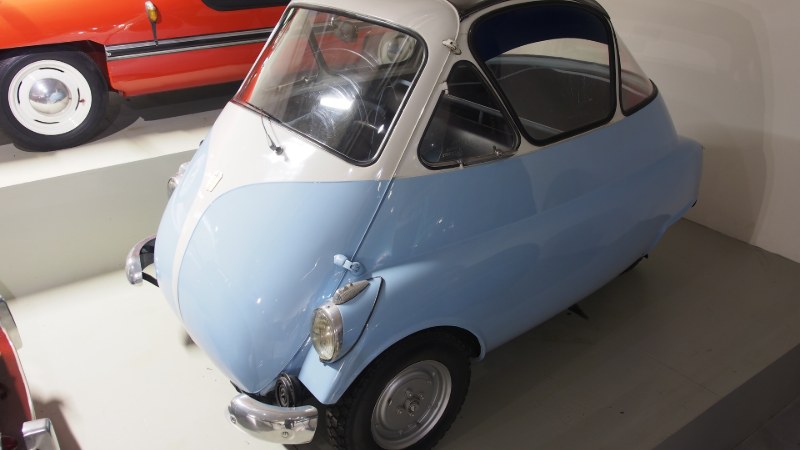
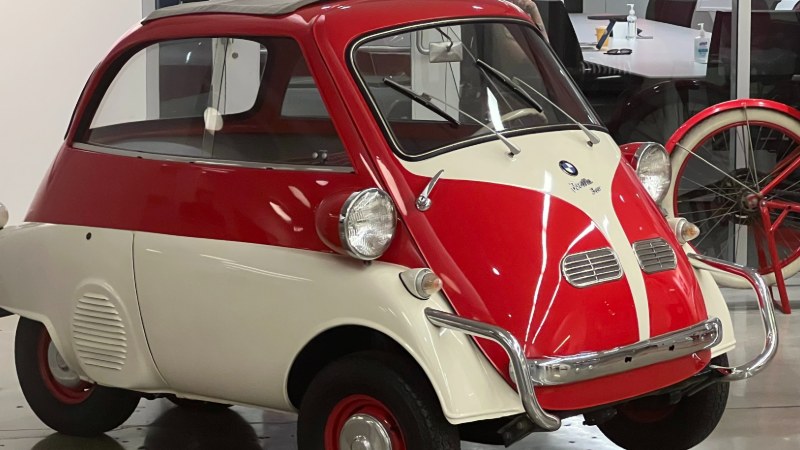
In the early 1950s, mobility meant for most people a bicycle, the moped, or the motorcycle. The number of passenger carsin West Germany in 1950 at only about half a million vehicles—the car was a privilege reserved for the few. It was precisely thisgap between two-wheelers and “real” cars that the idea of theultra-compact and scooter-style vehicles, which also included the Isetta: it offeredprotection from the elements and four wheels at a price that was close to that of a better motorcycle.
Thechange then took place with remarkable speed. In 1957, the number of registered passenger cars exceeded that of motorcycles for the first time – there were around 2.4 million cars compared to about 2.3 million motorcycles. By 1960 the number of passenger cars had climbed to about 4.5 million,&and over the course of the 1960s it was to double once more, reaching nearly 14 million. Within a decade, Germany had transformed from a nation of motorcyclists into a nation of car drivers.
What a car cost: from the Isetta to the “Adenauer”
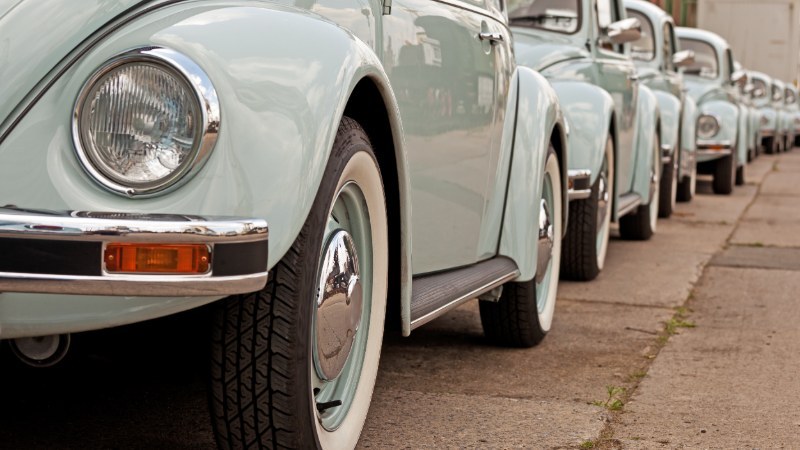
A glance at the new car prices shows just how wide the range of automotivedesires was is evident from a look at the new car prices of the 1950s. At the lower end was the BMW Isetta, which was available in 1955 starting at 2,580DM—for many, the first affordable step from a motorcycle to a closed car. The VWBeetle, the quintessential symbol of the economic miracle, cost around 3,750 DM in 1955. In themid-range segment, the Opel Rekord was priced at about 6,400 DM, while in the upper mid-range cars such as the Mercedes 180 ranged between approximately 8,500 and 10,500 DM.
At the top of the sedan market sat the Mercedes-Benz 300,simply called the “Adenauer” because of its most prominent user, Federal Chancellor Konrad Adenauer.At around 24,700 DM, it was one of the most expensive cars in the world—it cost about as much as three Cadillacs and remainedreserved for statesmen, businessmen, and celebrities.
The sports cars from Mercedes-Benz were in a league of their own. The 300 SL introduced in 1954 with its distinctive gull-wing doors cost around 29,000 DM and was thereby even more expensive than the “Adenauer”—a technical masterpiece with gasoline injection, which found buyers primarily abroad and among affluentsports car enthusiasts. Somewhat more accessible, though still afortune, was the 190 SL introduced at the same time: The elegant roadster with a four-cylinder engine waslisted at 16,500 DM in 1955. Both SL models conveyed a new message – that from Germany no longer produced only economical everyday cars, but also coveted world-class sports cars.
If one compares these prices to wages, the social significance of the car becomes tangible. With a gross monthly salary of just under 600 DM in the early 1960s, the Isetta cost about four to five months’ salary, while the Beetle cost about one and a halfyear’s income. An “Adenauer,” on the other hand, cost more than three full years’ salary of an average worker—acar that remained out of reach for the vast majority and precisely therefore made the gap between the social classes visible.
Mobility as a status symbol
The car was during the Economic Miracle, it was far more than just a means of transportation. It embodied social advancement, regainedfreedom of movement, and participation in the new prosperity. Anyone who made the switch from a moped to the Isetta, from the Isetta to the Beetle, and from the Beetle to a mid-range car,thus visibly achieved their own social advancement. The first vacation trips to Italy, whichlater came to be known in popular speech as the “travel boom,” were only made possible by their own vehicles.
In this story, the Isetta has its firm place. It was no stopgap solution, but for many families the gateway to automobility – the first roof over one’s head on four wheels, affordable on a normal salary. It thus symbolizes a decade in which mobility went from a privilege to a matter of course. Anyone looking at an Isetta or an early Beetle today sees not just a pretty piece of technology, but a vehicle that embodies the economic and social changes of an entire era.