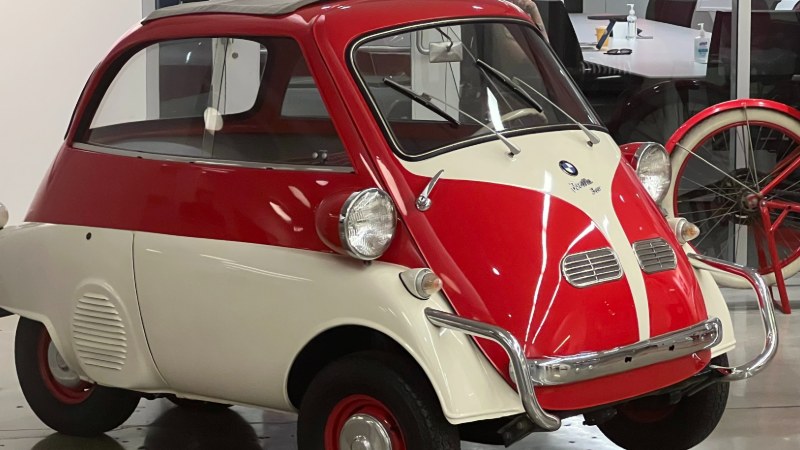
The Isetta is considered by many to be the ultimate German Economic Miracle car.&In fact, the idea originated in Italy: the microcar was developed by the companyIso in Bresso near Milan, long before BMW acquired a license. The history of the Iso Isetta is that of a bold design – and an entrepreneur who preferred to sell licenses rather than go into mass production himself.
From refrigerator to the microcar
Behind Iso stood the engineer and entrepreneur Renzo Rivolta.&In 1939 he founded the company Isothermos, a manufacturer of cooling and heating equipment; following a bombing raid on Genoa, he relocated the business to Bresso in 1942. After the war, Rivolta shifted to two-wheelers. Isothermos became Iso Autoveicoli, which by 1950 became the third-largest Italian two-wheeler manufacturer after Vespa and Lambretta.
Rivolta wanted more. In 1951 he commissioned the two aerospace engineers Ermenegildo Preti and Pierluigi Raggi to design an exceptionally small automobile, powered by one of the company’s own motorcycle engines. nbsp;The designers’ aeronautical background is evident in the result: lightweight construction and consistent space utilization characterized the small car, which was introduced in 1953 as the “Isetta”—the “little Iso”—was unveiled at the Turin Motor Show.
Design and Technology
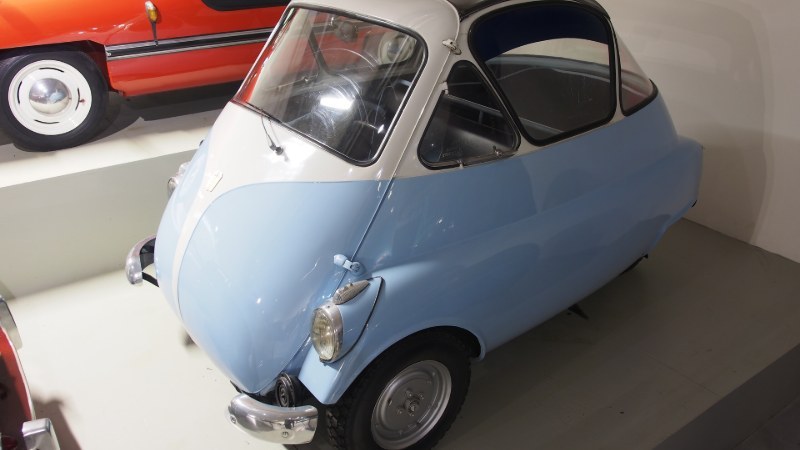
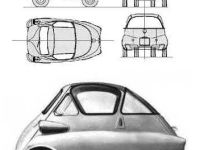
The Iso Isetta was a curiosity on four wheels. The egg-shaped body maximized interior space and glass surfaces, andentry was through a single door that swinged forward, causing the steering column to side—a concept that was later also adopted by the BMW Isetta. At the rear were two wheels positioned close together, with a track width of only about 48 centimeters. This narrow rear axle made a differential superfluous: With such a small distance between them, the differences in rotational speed of the wheels in the curve barely matter at all. The first prototypes even had only a single rear wheel, but they tipped over too easily—the twin-wheel solution was the pragmaticcompromise.
Power was provided by an air-cooledtwo-cylinder two-stroke engine with a displacement of 236 cm³ and approximately 9.5 hp (about 7 kW). With this, the Isetta, which was just under 2.3 meters long, reached a speed of about 75 km/h.&A two-stroke engine burns a fuel-oil mixture every other stroke instead of every fourth, making ittherefore simple and lightweight, but thirsty and emission-prone – for an economical city runabout of the early 1950s, however, it offers exactly the right amount of technology.
Mille Miglia and the licensing strategy
That the Isetta was more than a curiosity was proven Rivolta in a spectacular way: In 1954, Iso sent several Isettas to the legendary Mille Miglia. In the fuel consumption and economy rankings, they took the top spots and maintained an average speed of over 70 km/h over the approximately 1,600 kilometers. An even more effective advertising campaign for a economical car was hard to imagine.
Commercially speaking, the Italian Isetta remained a modest success, however. The figures regarding production volumes vary depending on source between around one thousand and several thousand units; Italian production ceased as early as 1955. The reason was not a lack of quality in the design, but rather Rivolta’s strategy. He had bigger plans and consistently focused on the licensing business instead of investing capital in his own mass production.
The licensing business: BMW, VELAM and Romi
BMW became the most important partner. The Munich-based company purchased not only the license, but also the entire body tooling set— and turned the Italian design into the most produced Isetta variant with its own four-stroke engine the most-produced Isetta offshoot. In France, VELAM acquired a license and began 1955, it produced its own body based on the Iso-Motor, since thestamping dies had indeed been moved to Munich. In Brazil, in turn, the machine builder Romi manufactured the Isetta under license: The Romi-Isetta is considered the first automobile produced in Brazil and rolled off the assembly line in September 1956, with approximately 3,000 units produced by 1961. Production also took place in Spain.
Thus, paradoxically, the little Iso became a a global success without the inventing company holding the largest share of units. Rivolta had achieved what he wanted: Others bore the production and sales risk, while his name lived on in every licensed model.
What remained of Iso
Renzo Rivolta used the Isetta as a stepping stone.&In the 1960s, Iso transformed from a microcar manufacturer into a sports car manufacturer: With the Iso RivoltaIR 300 and the Iso Grifo, elegant GranTurismo models with powerful American V8 engines—the exact opposite of the frugal Isetta. After Rivolta’s early death in 1966, his son Piero took over the company, until Iso was forced to close in 1974.
The Iso Isetta itself is now a sought-after classic and an important piece engineering history. It was the actual origin of the “knutschkugel,” the proof that a car based on make families mobile—and the model without which the famous BMW Isetta would neverexisted. Anyone familiar with the original sees the German version in a different light.
Image source:&https://commons.wikimedia.org/wiki/File:1953_ISO_Isetta_236cc_10hp_70kmh_photo1.JPG - Author: Alf van Beem - License: Public Domain